
It’s been a pretty huge few months for space nerds, or so I hear. I wouldn’t necessarily call myself a space nerd – I don’t pretend to know the science, but I admire it from afar. Like any self-respecting writer, I romanticise the moon; plus, my name means star in latin so I feel a certain level of affinity with a bunch of gaseous balls… um. I’m getting off topic here.
If you’ve been consuming media lately, chances are you’ve seen parts of the Artemis II mission, or heard about the movie adaptation of Project Hail Mary by Andy Weir. I don’t typically reach for hard sci-fi books, but everyone was raving about this one so I decided to give it a go before watching the movie. Perhaps I made the mistake of doing a little sleuthing online prior to reading the book, and as with anything that gets loads of praise, there was a smattering of criticism and your typical vagueposting along the lines of “I stopped reading Andy Weir when I found out about his politics…”
Of course, I couldn’t unearth anything substantial about his politics; the best I could find was this quote which has been circulating recently:
I dislike social commentary. Like… I really hate it. When I’m reading a book, I just want to be entertained, not preached at by the author. Plus, it ruins the wonder of the story if I know the author has a political or social axe to grind. I no longer speculate about all possible outcomes of the story because I know for a fact that the universe of that book will conspire to ensure that the author’s political agenda is validated. I hate that. I put no politics or social commentary into my stories at all. Anyone who thinks they see something like that is reading it in on their own. I have no point to make, and I’m not trying to affect the reader’s opinion on anything. My sole job is to entertain, and I stick to that. To that end, I also don’t talk about my personal political opinions publicly. I don’t want readers to even know, honestly. I don’t want that in the back of their minds as they read my stuff.”
Ah, so the vagueposters stopped reading Weir’s work when they found out that his politics are… you don’t get to know 🚫 I kinda feel like we’re scraping the bottom of the cancel culture barrel here guys. At what point do we have to acknowledge that other people have differing viewpoints and ideas and they can actually still produce intriguing and valid art.
To be clear,1 I think Weir’s take is a bad one. It’s also from an interview that’s eight years old, so there’s a chance he’s grown and changed a little since then. But beyond the baffling idea that any work of art – or person, for the matter – can exist in a political echochamber, it’s laughable that Weir thinks his work is politically neutral. I’ve only read Project Hail Mary so I can’t comment on the others, but I would not have guessed for a second that Weir was making an effort to keep his politics out of it. Sure, it’s not as overt as something like The Handmaid’s Tale or The Hunger Games, but it does (spoilers ahead!) propose a world in which almost every single country bands together to stop humanity from being wiped out. It features a huge, fully funded scientific endeavour and an interstellar2 mission with crewmembers from across continents. The main character also shuts down climate change denial and contemplates what pronouns to use when he meets an alien. That sounds at least a little political to me, but I guess I’m just reading into it on my own. Woopsies!
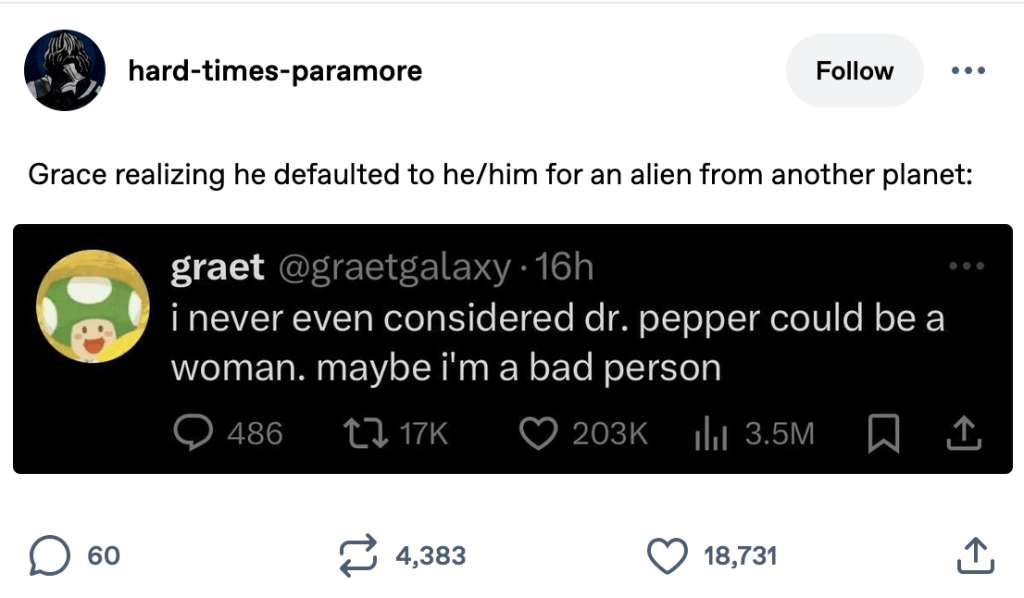
So why would Andy Weir say this? I don’t know, but I have a few hypotheses that I’d like to present to you:
- As a (pardon my language) straight white male™ he’s unaware (unaweir?) of his political existence. This might sound like a joke, but I do think it’s possible: when you’re born into a body and a life that is normalised, accepted, and empowered, you’re far less likely to notice the everyday ways in which society affects you. At least, not in the same way that a marginalised person will notice them – Weir is able to buy into the “privileged experience” that doesn’t have to experience all of the microaggressions and shitty ways in which society wears us down. Maybe Weir sees “politics” as like… mayoral campaigns and social commentary; he doesn’t even realise that everything he does is political!
- Weir is completely exhausted by the current political climate and wants to create a fictional world in which it’s not such an all-encompassing thing. If true… kinda valid. Many of us read books for escapism and it’s pretty clear to me that Weir writes for this reason too. And I can fully understand feeling unenthused (to put it mildly) by today’s politics – I mean, there’s stuff that really shouldn’t be considered quote-unquote “political” but very much is, like universal healthcare or climate change. As a scientist, Weir knows that climate change is real, and it’s in his novel because it’s relevant to the story, but some readers might find that too woke for their tastes.3 Of course – as mentioned in my first point – it’s impossible to just “opt out” of politics, and I don’t feel like Weir actively tries to avoid it in Project Hail Mary. Eva Stratt is a character that stands out to me because of her political nuance: she’s a ruthless bureaucrat who will do anything to save humanity, sacrificing her own humanity to do it. She gets taken to court for copyright infringement when she authorises that every piece of digital media be available to the astronauts on the Hail Mary mission; she knows that she will likely be imprisoned when shit really hits the fan because the world will need someone to blame. She forces Ryland Grace onto a suicide mission against his will because she knows it is the best chance for the mission to succeed. Her actions are by no means morally pure, and yet her choice is the right one – against all odds, the mission succeeds. She’s not a “good” person but she is working for the “greater good,” and that is what makes her character so… great!4
- Andy Weir is too preoccupied with writing a juicy, entertaining story to realise that bits of social commentary are slipping through. Weir has talked a lot about how he finds it challenging to write complex, interesting characters, and how he takes on feedback from his readers to improve his writing for future novels. Perhaps readers actually want to read characters that are flawed and relatable and from different backgrounds who encounter aspects of our society and respond to them in different ways! Could it be that what makes a story truly entertaining is when it presents our world in a slightly new or unexpected way and – in doing so – reveals something about the human experience and even makes us think about how we live our lives? Nah, that can’t be it. It’s when Romulans and the Federation shoot at each other.5
I think it’s probably a combination of those three things, but I find the last one to be the most amusing – and the most convincing. Did we really trick Andy Weir into diversifying his characters? Maybe!
I say this because I watched a much more recent interview for the Inklings Podcast (shout out Jack Edwards, I love you!) that focused a lot on Weir’s writing process and the development of his craft. Knowing about the whole “a-political” stuff, I guess I had built up this image of Weir as your standard, obliviously arrogant white guy,6 so I was really surprised by how humble he was about his writing. He’s very candid about his writing weaknesses, admits to his MacGuffins, and criticises his own work. He says that Ryland was “the first main character that I ever made that wasn’t just based on my own personality… I’m trying to grow as a writer, I want to make a character that’s not just me.” He talks about what he has learned from his past books, and kinda rips into his protagonist from The Martian, who apparently had “no personality, no character at all” (I haven’t read this book so I can’t comment).
It’s clear to me that Weir doesn’t see himself as this revered, irreproachable artist: he is constantly working to improve his writing and thinks a lot about how to do that. I find that pretty admirable, especially for someone who has been a bestselling author for over a decade. He’s also obviously not perfect (see: the start of this article), and that’s cool too; funnily enough, none of us are.
Unfortunately for Mr Weir and his opinions, I was taught during my English degree that anything can be analysed,7 and so the rest of this post will be a review/analysis of Project Hail Mary. As I’ve already mentioned, spoilers ahead – in fact, this is really for the people already familiar with the book and/or movie, because I won’t be providing a plot summary. I’m going to talk about the book and the film somewhat interchangeably, because the movie was genuinely one of the most authentic and thoughtful screen adaptations I have seen. Don’t you love it when that happens!!
First, I wanted to touch on the level of artistry in the movie – maybe some part of me was expecting ye olde generic blockbuster/Marvel sort of shtick, but that could not have been further from what we got! Every single aspect of the film felt so carefully considered and crafted: the soundtrack is unlike anything else,8 the cinematography is absolutely sublime (I hope we’ve all seen The Moment™), the detail to Rocky’s character design and the effort involved in practical effects and puppetry is truly a balm to my soul. People care! They still care!!
But I digress. Since reading and watching PHM (which I did all within the space of a week), I keep returning to Grace and Rocky. The book is about a desperate mission to save life on earth, but at the core of the story is a profound friendship between a human and an alien. In the middle of space, light-years away from earth, a human meets a creature that is pretty much as “other” as you get – especially in appearance, Rocky is described as “spider-like” and a “scary space monster” (though that one is played for humour). While Grace is definitely scared at first, he never reacts in a violent or defensive way; he communicates with the alien however he can, and slowly they learn each others’ languages. They learn from each other, they change each other, and Grace’s mission shifts to include helping all life on Erid. Grace Rocky save stars.
Andy Weir writes a dynamic that is fun, complex, and moving, but I would also argue that it’s unusual and (block your ears Mr Weir) progressive. While reading the book, I wondered if there would be any sort of romance introduced – it would have been easy to create something between Grace and Stratt, and I’m sure your run-of-the-mill blockbuster would have shoe-horned a kiss in. I’m not one to hate on romance sneaking into other genres – far from it – but I found myself really hoping this wouldn’t happen in PHM. And whew! It didn’t.9 And that’s because the true relationship of the story is not a romantic one; it’s platonic. To see an interspecies, intergalactic friendship front and centre like that… I don’t think it’s all too common.
Rocky and Grace aren’t just best buds – they’re platonic soulmates who perform acts of sacrifice for each other. This happens in big and small ways, but it’s most obvious in the dichotomy of bravery and cowardice. Grace is on a suicide mission and though he doesn’t know how he got there, he assumes he volunteered. Even as he starts to recall his past, it’s only towards the end that he remembers he was drugged and forced onto the spaceship. Suddenly, he has to reckon with the fact that his perceived bravery was a lie – except it wasn’t. Because not long after this revelation, Grace embarks on a suicide mission to save Rocky and his planet – an alien species on a world Grace has never seen and has objectively less of a reason to sacrifice himself for. But he does, and he does it for his friend.
This is simply and beautifully articulated in the movie: when Grace meets the intended crew of the Hail Mary mission, he tells Commander Yáo that he doesn’t have the “bravery gene” that the crewmembers all must have. “It’s not a gene,” Yáo responds. “You just need to find someone to be brave for.” As the film develops, Rocky becomes that someone for Grace; even when Stratt mentions the schoolchildren Grace teaches in a last-ditch effort to convince him to join the mission, he would rather live on earth than die for them. But for a strange, rock-like alien from a different solar system, Grace is brave enough to abandon his only chance at getting home and instead return to Rocky.
They’re also soulmates because, in a way, they’re destined to meet. This is alluded to in the story (if you squint), but I think it goes beyond the science and into the celestial.10 Are Grace and Rocky star-crossed lovers? No, but also… kinda (after all, they cross the stars to meet). Both of their species have developed at a similar pace, have been affected by astrophage at a similar time, and have figured out enough about it to go looking in the same place for a solution. That’s all on a macro-level, but we can get into specifics too: neither Rocky nor Grace were the leaders of their respective missions, and yet they are the sole survivors; both have survived purely by chance, and when they meet, they happen to be exactly what the other needs. Alone, they don’t have the means to save their worlds, but together they have the science and the equipment and the knowledge and the curiosity and the determination. They keep each other alive and safe and sane and loved. They watch each other sleep.
Of course, all of this happens because Andy Weir was planning out a sci-fi novel and he wrote it that way. But that’s the beauty of storytelling! Yes, Grace and Rocky meet against all odds, but they also meet because they were fated to meet, because it was always meant to happen that way. There’s something of Orpheus and Eurydice in their story, only here, it is the precise act of turning around that saves them both, when every other time they would have been damned.
Okay, I think that’s enough aggrandising statements for one day. Back to my original question: is Project Hail Mary political? If you asked Andy Weir, I imagine he’d say no. And it’s no secret that my interpretation is informed by my own experiences and pre-existing viewpoints. Maybe it’s just the dumpster-fire of current events being blasted into my brain every five seconds by the internet, but it felt pretty radical to read an unequivocally hopeful novel – a story that presents an optimistic (though not necessarily naïve) picture of the world. Hope is not just entertainment or escapism – I think it is precisely what we need right now. We have to believe that we as a species are good, and we have to hold ourselves and others to that belief.11
I think Weir would agree that his book is about the fundamental goodness of humanity; I find it fascinating that he also posits the idea that this inherent “goodness” is not unique to humans. Of course, we have evidence of this on our own planet – many species of animals have the ability to protect, nurture, and mourn – but would we find this if we travelled across the stars? If we found Rocky… yes. Intentionally or not, I think Project Hail Mary asks us a pretty urgent question: what if communication is what will save us? What if knowing and being known by the “other” is the key – not only to our survival, but to the deepest, most profound relationship of our lives?
- Please don’t cancel me!! I promise all my opinions are super correct and ethical!! ↩︎
- I hardly know her! ↩︎
- If you’re a climate change denier, allow me to present this argument to you: it’s real. ↩︎
- I wonder if Andy Weir conflates “politics” in fiction with being “politically correct”? ↩︎
- I haven’t watched Star Trek (beyond catching the occasional snippet during my mum’s twentieth rewatch), but that doesn’t stop me from knowing this is a wild take lol. ↩︎
- Sorry to white guys everywhere!!! ↩︎
- MUAHAHAHAHAHAHAHA ↩︎
- I’m listening to it as I write which is actually a bit difficult because I keep ascending to another plane of existence. Daniel Pemberton you BETTER win all the awards!! ↩︎
- Slightly different story in the film – they alluded to the possibility of something maybe romantic in a subtle way that I wasn’t mad at and I think actually made the dynamic between Grace and Stratt all the more interesting. But that’s another essay! ↩︎
- Bear with me here while I get a bit poetical about storytelling ↩︎
- Maybe that’s the real punk rock! ↩︎
Check out all my writing about books, movies, media etc over on my Substack! >>>


